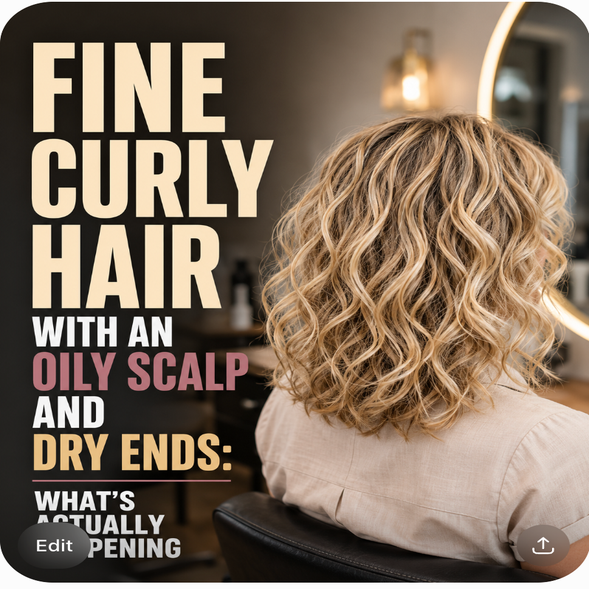
For years, “hygral fatigue” got passed around the curly hair world as a scary catch-all: get your hair too wet and it falls apart, so cut back on water and rebalance it with protein. Then it started getting debunked, and on the narrow point, there is a fair case. There is not much evidence that ordinary, occasional washing harms healthy hair; water’s weakening effect on a strand is real but temporary, easing as the hair dries[1].
I am all for the science, and if I used the wrong term for what happened to me, I am genuinely open to a better one. But I cannot pretend it did not happen. My curls really did turn gummy, weak, and lifeless, twice. It reminds me of how women described perimenopause for years before the word was common; the symptoms were real long before there was a name everyone agreed on, or an expert ready to take them seriously. A label catching up late does not make the experience imaginary. I worked through all of this with my friend, a hair scientist and cosmetic formulator with a PhD in chemistry, to separate what is real from what got exaggerated.
And here is why the name still fits, even loosely. “Hygral” comes from the Greek hygros, which means moist or wet, but also, tellingly, soft, weak, and flexible[2]. “Fatigue” is what happens to a material stressed over and over: it weakens, and then, crucially, it can recover once the stress lets up. That pairing describes what I went through almost exactly. This was not the ordinary wetting that happens when you wash and fully dry your hair.
My mistake was keeping my hair damp almost continuously for months, rewetting it through the day and adding leave-in again and again before it ever dried, so my strands stayed soft and swollen far more often than hair is built for. Over time they weakened. Then they came back once I changed what I was doing, and that recovery is the tell, because you do not recover from destruction; you recover from fatigue.
So this post does two things: it takes the science seriously, and it tells you exactly what happened to my hair, why it was never really about “too much moisture,” and the simple change that brought it back.
Is Hygral Fatigue a Real Scientific Term?
The words are real; the popular definition is not. The term traces back to fiber and textile science, borrowed from decades of wool research, where the repeated swelling and contracting of a wet protein fiber is described as hygral expansion or hygrostress[3][4][5]. Wool and hair are both protein fibers and behave similarly when they get wet, which is how the hair world inherited the phrase. So “it is not a real term” is not quite right either. The problem is what the curly hair community layered on top of it.
The popular version says hair takes on “too much moisture,” goes limp, and needs you to rebalance moisture against protein. That part does not hold up. A strand’s water content is governed by the humidity around it, not by how much water or product you pile on, so you cannot saturate it with permanent extra water the way the phrase implies[6].
The hydrogen bonds that water temporarily loosens simply reform as the hair dries, which is why ordinary washing does not, by itself, wreck healthy hair[1]. There is no internal moisture-protein gauge waiting to tip; what you can change is not how much water a strand stores, but how often it swells.
So does ordinary showering, cleansing, or rinsing cause hygral fatigue? For healthy hair, no. What is real is narrower and more mechanical: hair kept swollen and wet far longer and far more often than normal, especially hair that is already worn, can fatigue over time. That is the version I lived, and understanding the difference is the whole point of what follows.
What Is Hygral Fatigue, Really?
Hygral fatigue is fatigue in the engineering sense: a material weakened by repeated stress cycles, the way a paperclip snaps after you bend it back and forth enough times. For hair, the stress is water. Every time a strand gets wet it swells, and as it dries it shrinks back[3].
Each swell-and-shrink cycle is tiny, but repeated often enough on a vulnerable strand it wears the cuticle and strains the cortex underneath, leaving hair weak, overstretchy, and prone to breakage[4][7].
What does the damage is the repetition of that cycle on a strand that is already fragile, not a quantity of stored water. That distinction changes the fix entirely: you reduce how often the hair swells and protect the fiber, rather than chasing some internal moisture-protein ratio.
The Myth Almost Every Article Repeats
Search “hygral fatigue” and you will read, over and over, that it means your hair has too much moisture and not enough protein, and that the cure is to rebalance the two. Big brands and curl blogs repeat it, usually phrased as hair “crying out for balance.” I understand why; it is a tidy story, and it is the language the whole community grew up on, myself included. Beyond the “too much moisture” mistake I already covered, it misreads the science in two more specific ways.
Protein is not the opposite of moisture. There is no moisture-protein seesaw to balance. Protein is one kind of conditioning and reinforcement; it can temporarily strengthen a weakened strand, but it is not a counterweight you add to cancel out water[8]. I go deeper on this in the protein guide linked below.
Hygral fatigue and “over-conditioning” are not the same thing. They get used interchangeably, but one is mechanical fatigue from repeated wetting and the other is usually buildup or under-cleansing. They are different problems with different fixes, though they can happen at the same time, which is exactly what happened to me.
Treating one as the other is how people stay stuck. If what you are dealing with sounds more like product heaviness or mushiness without much water exposure, that is the buildup story, and I break it down in Moisture Overload vs Protein Overload. This post is about true hygral fatigue: the water-swelling kind.
Why Curly and High-Permeability Hair Is More Vulnerable

Hygral fatigue can affect any hair, but curly hair and damaged hair are more exposed to it, for a reason worth understanding. The cuticle is the strand’s protective outer layer of overlapping scales[7].
When that cuticle is worn, lifted, or cracked, often called high porosity, water moves into and out of the strand faster and more freely[9]. I prefer to describe this as how permeable to water the strand is, because the issue is the condition of the cuticle, not a fixed hair “type” you are stuck with. You can read the full picture in the high porosity care guide and the low porosity care guide.
A more permeable strand swells faster and more dramatically with each wetting, so the fatigue cycle hits harder[5]. And because that permeability usually comes from existing damage (color, bleach, heat, friction, chemical services), the strand is already weakened before the water cycling even starts[10].
Tighter, less-damaged cuticles let water through more slowly, so that hair swells less and is at lower risk. None of this means low porosity is “good” and high porosity is “bad”; it means a damaged cuticle simply has less margin, and the swelling cycle uses up what little is left.
Signs of Hygral Fatigue (and What They Actually Mean)

The signs all point back to one thing: a strand that has lost its elasticity and structural integrity from too many swelling cycles. Look for:
- A gummy, mushy, or spongy feel when wet, almost like wet cotton candy.
- Curls that stretch easily and then stay stretched or snap, instead of springing back.
- Limp curls with no bounce, volume, or shape retention.
- Frizz and a rough surface that styling does not fix for long.
- In more advanced cases, breakage during gentle handling.
Notice that several of these overlap with other problems: limpness can be buildup, frizz can be cuticle damage from any cause, and breakage has many sources. That overlap is exactly why hygral fatigue is so often misdiagnosed.
The distinguishing clue is the gummy, overstretchy, weightless feel combined with a history of frequent or prolonged wetting. If your hair has not been getting repeatedly soaked, it probably is not hygral fatigue.
The Wet Strand Test: What It Can and Cannot Tell You

The wet strand test has been tied to hygral fatigue for years, and unlike in some other contexts, it is actually measuring the right property here.
Wet a strand, stretch it gently, and watch what it does. A healthy strand stretches a little and springs back; a fatigued one stretches a lot and stays stretched, or snaps with barely any resistance. That is a real read on elasticity, which is exactly what hygral fatigue degrades[11]. As a quick directional clue, it works.
What the test cannot do is tell you to “add moisture” or “add protein” to fix a balance. There is no balance being measured; a strand with no spring is simply a weakened, damaged strand. What it is telling you is this hair is fragile, handle it gently and stop stressing it, not which side of a seesaw to feed.
Read it as a strength check, and pair it with the more reliable habit of watching how your hair behaves over several wash days rather than reacting to one strand.
My Experience: What Hygral Fatigue Actually Felt Like

When I started my natural hair journey, my hair was already severely damaged: years of flat irons, bleach, and thinning had left it brittle and severely dry. So I did what the OGs on social media and YouTube told all of us to do back then. Dry hair needs moisture, so I went all in on moisture. I co-washed exclusively for months, no shampoo at all, because clarifying was treated as forbidden under the Curly Girl Method. And because my hair still felt so dry, I rewet my entire head throughout the day, reapplying water and a leave-in conditioner to keep it “hydrated.”
Here is the specific mistake, the one almost everyone misses: I was rewetting and reapplying leave-in before my hair ever had the chance to dry from the time before. My hair was not just getting wet during washes. It was living in a near-constant wet state for months. And water makes hair fragile while it is wet, so my strands were soft, swollen, and vulnerable almost around the clock, never getting the dry, contracted hours that let a fiber recover.
I want to pause here, because this is exactly where people get dismissed. The common pushback is, “we all wet our hair every time we shampoo, so how could hygral fatigue possibly be real?” That misses what actually happened. Of course hair gets saturated when you wash it; that is normal, and it dries afterward.
What I did was different in kind, not degree: I kept my hair perpetually wet and swollen for weeks on end. Telling someone hygral fatigue cannot exist because your own hair survives ordinary washing is not science; it is dismissing an experience you did not have. The mechanism is real, and the trigger is sustained, repeated swelling, not the occasional wash.
On top of the constant wetness, never cleansing meant the conditioning agents from all those co-washes and leave-ins had nowhere to go. They just accumulated. So by the end I had two things happening at once: a fiber worn fragile from being endlessly wet and swollen, and months of conditioning buildup with no clarifying to remove it.
My curls went limp, overly mushy, and felt like they would literally disintegrate. I had never experienced anything like it, and I was scared, because I had no idea what was happening or how to undo it.
What finally turned it around was the very thing the method had told me never to do: I clarified. A clarifying shampoo stripped out the layers of accumulated conditioning agents I did not even know were the problem at the time, and that was the turning point. I learned the science behind all of it only later. At the time I just knew my hair came back to life once I cleansed it and stopped keeping it wet.
Clarifying was the reset, but it was only half of it. Months of living in a swollen, fragile state had left my strands genuinely weak, with no structure or spring left in them, so once I had cleared the buildup, I reached for protein to rebuild what the swelling had worn down. I used the Aphogee Two-Step Protein Treatment, and it brought real strength and structure back into my hair.
This is protein doing its actual job: reinforcing a fiber that was truly weakened, not “balancing” some imaginary ratio against moisture. The combination is what worked: clarifying removed what was weighing my hair down and keeping me confused, and the protein treatment rebuilt the strength that constant wetness had stripped away.
How to Recover from Hygral Fatigue
Recovery is not about rebalancing anything. It is about giving a worn-out fiber fewer stress cycles and more protection while it grows out and rebuilds. Here is the approach my collaborator and I landed on[12], adaptable to your own hair.
1. Reduce how often your hair swells
This is the single most important step, because frequency of swelling is the actual cause. Stop daily rewetting. Space out wash days, avoid long soaks, and let your hair dry fully between any water exposure. If you refresh between washes, lean on methods that do not resaturate the whole strand.
2. Use a penetrating oil as a pre-wash buffer
This is where coconut oil earns its reputation, and the evidence is genuinely strong. Coconut oil is unusual: because of its low molecular weight and straight-chain structure, it actually penetrates the strand rather than just sitting on top, and once inside it reduces how much the fiber swells with water and cuts protein loss during washing[13][14].
Used as a pre-wash treatment for a few hours or overnight, it buffers the swelling cycle from the inside[15]. If coconut oil does not suit your hair, another penetrating oil like sunflower can help, though coconut is the standout.
3. Cleanse properly, especially if buildup is muddying the picture
If heavy products or conditioner films are part of what is making your hair feel mushy, a proper wash clears them so you can see the real state of the strand[16]. You do not need to fear cleansing here; regular shampoo handles most buildup.
Reserve a stronger clarifying wash for when product or mineral buildup is clearly the issue, not as a routine reflex. If you suspect buildup more than water damage, the moisture overload guide guide walks through that distinction.
4. Reinforce a weak strand with protein, used correctly
A genuinely weakened, low-elasticity strand can benefit from a strengthening treatment, because protein temporarily reinforces the fiber and improves resilience[8][17]. This is not about balancing moisture; it is about propping up a fragile strand while it recovers. Use it when the hair is actually weak, follow it with a conditioner for slip, and do not overdo it. For how to choose and use these, see my favorite protein treatments.
5. Be gentle, and let time do the rest
Fatigued hair is fragile hair, and wet hair is the most fragile of all, so detangle slowly, avoid aggressive brushing, and minimize heat. Hygral fatigue does not reverse on damaged length the way people hope; protein and care buy time and improve feel, but the truly worn sections recover fully only as they grow out or get trimmed. Patience is part of the protocol.
What I Reached For
Everything below is what I personally used to recover, by job, not a prescription. Your hair will tell you what it needs.
To clarify: Kinky Curly Come Clean. I clarified with every wash until the weeks of conditioning buildup was gone, then went back to my regular shampoo. The point was removing the accumulated films, not clarifying forever.
To buffer the swelling: coconut oil, a pre-wash treatment before every wash, applied a few hours to overnight, so my strands swelled less every time I cleansed.
To rebuild strength: the Aphogee Two Step Protein Treatmen the severe stage, when my hair had no structure left. Once I felt real structure coming back, I laid off the Two Step and stepped down to the gentler Aphogee Two-Minute Keratin Reconstructor for maintenance. Curl Junkie Repair Me does a similar reconstructive job and is also excellent, just more expensive.
Preventing Hygral Fatigue: Curl Care and Overnight Routine
Once you understand that frequency of swelling is the cause, prevention gets simple. The goal is fewer, gentler water cycles and a protected cuticle.
- Do not sleep on soaking-wet hair. Going to bed with drenched hair keeps it swollen for hours and is a classic trigger. If you wash at night, let hair dry as much as possible first.
- Protect your curls overnight. This matters most when strands are already weak and breaking, because the damage is mechanical.
- A cotton pillowcase has a rough, absorbent surface, and dragging fragile, swelling-worn hair across it all night creates constant friction that lifts and roughens the cuticle and snaps compromised strands; cotton also wicks water, which can keep already-vulnerable hair in that swollen state longer.
- A silk or satin pillowcase or bonnet has a smooth, low-friction surface that lets hair slide instead of catch, and a loose pineapple or loose braids reduce the tugging further.
- A solid curly hair night routine is as much about protecting curls overnight as it is about preserving the style, and it keeps you from needing to rewet and restyle every morning, which is what drives the swelling cycle in the first plac
- Refresh without resaturating. To revive curls in the morning, mist lightly or use a little leave-in on the surface rather than soaking the whole head. Learning to refresh instead of rewet is one of the best frizz control habits for curly and wavy hair, and it keeps you from needing to rewet and restyle every morning, which is what drives the swelling cycle in the first place.
- Buffer with a pre-wash oil. A coconut oil pre-poo before wash day is preventive, not just corrective; it limits swelling every time you wash.
- Address the damage that made hair permeable in the first place. Since bleaching, heat, and chemical services are what lift and crack the cuticle, reducing those protects you long-term far more than any product can.
Hygral Fatigue FAQ
Does washing your hair every day cause hygral fatigue?
Not by itself, but frequent wetting is the main driver, so daily washing or rewetting raises the risk, especially on damaged, high-permeability hair. What matters is how often the strand swells and whether it dries fully in between. Wash on the schedule your hair and scalp actually need, and avoid leaving hair half-wet for long stretches.
Does air drying cause hygral fatigue?
No. Air drying is gentler than heat drying and does not cause hygral fatigue on its own[18]. The risk comes from the repeated wetting cycle, not the drying method. The one thing to avoid is constantly rewetting hair before it has fully dried, which keeps it swollen far longer than necessary.
Can hair recover from hygral fatigue?
Yes, with patience. Reduce how often the hair swells, buffer it with a penetrating oil, clarify if conditioning buildup is part of the picture, reinforce genuinely weak strands with protein used correctly, handle it gently, and minimize new damage. Feel and elasticity improve with care, but severely worn sections fully resolve only as they grow out or are trimmed.
How do you know when it is okay to go back to your regular routine?
Recovery time varies, so do not be discouraged if you need to repeat the steps a few times before your hair feels strong again; that is completely normal, and some sections recover faster than others. Watch the cues your hair gives you. A gentle wet strand test helps: when a stretched strand starts springing back instead of staying limp or snapping, that is your sign the fiber is regaining strength and you can ease off the corrective steps. Let your hair’s actual behavior, not a calendar, tell you when to stop.
Is hygral fatigue the same as over-conditioned hair?
No, and conflating them is the most common mistake online. Hygral fatigue is mechanical damage from repeated water swelling. Over-conditioning is usually buildup or product heaviness from rich products and not enough cleansing. They can feel similar and can even happen together, but the fixes differ: one needs fewer water cycles, the other needs better cleansing. The moisture overload guide covers the difference in full.
The Bottom Line
Hygral fatigue is real, but it is not what most of the internet says it is. It is not too much moisture, and it is not a moisture-protein balance gone wrong. It is a fatigue injury: a fragile strand worn out by swelling and shrinking too many times.
Once you see it that way, the fix follows naturally: swell the hair less often, protect the cuticle, reinforce genuinely weak strands without overdoing protein, handle everything gently, and give it time. That is how I brought my own curls back, and it is the honest, science-backed version of a story the rest of the search results keep getting wrong.
References
- Robbins CR. Chemical and Physical Behavior of Human Hair. 5th ed. Berlin: Springer; 2012.
- Online Etymology Dictionary. “hygro-” (Greek hygros: wet, moist; also weak, soft, flexible). etymonline.com.
- Feughelman M, Robinson M. A note on the significance of hygrostress in wool fibers. Text Res J. 1971;41(9):784–785.
- Dhingra RC, Postle R, Mahar TJ. Hygral expansion of woven wool fabrics. Text Res J. 1985;55(1):28–40.
- Bouillon C, Wilkinson J. The Science of Hair Care. 2nd ed. Boca Raton: CRC Press; 2005.
- Barba C, Méndez S, Martí M, Parra JL, Coderch L. Water content of hair and nails. Thermochim Acta. 2009;494(1–2):136–140.
- Gamez-Garcia M. Moisture in the cuticle sheath: effects on hair mechanical and cosmetic properties. J Cosmet Sci. 2021;72:687–696.
- Neudahl GA. Proteins for conditioning hair and skin. In: Schueller R, Romanowski P, eds. Conditioning Agents for Hair and Skin. Taylor & Francis; 1999:139–166.
- Gavazzoni Dias MFR. Hair cosmetics: an overview. Int J Trichology. 2015;7(1):2–15.
- Monselise A, Cohen DE, Wanser R, Shapiro J. What ages hair? Int J Womens Dermatol. 2015;1(4):161–166.
- Benzarti M, Pailler-Mattei C, Jamart J, Zahouani H. The effect of hydration on the mechanical behaviour of hair. Exp Mech. 2014;54(8):1411–1419.
- Aguh C. Developing a healthy hair regimen. In: Aguh C, Okoye GA, eds. Fundamentals of Ethnic Hair. Cham: Springer; 2017:79–89.
- Rele AS, Mohile RB. Effect of mineral oil, sunflower oil, and coconut oil on prevention of hair damage. J Cosmet Sci. 2003;54(2):175–192.
- Ruetsch SB, Kamath YK, Rele AS, Mohile RB. Secondary ion mass spectrometric investigation of penetration of coconut and mineral oils into human hair fibers. J Cosmet Sci. 2001;52(3):169–184.
- Keis K, Persaud D, Kamath YK, Rele AS. Investigation of penetration abilities of various oils into human hair fibers. J Cosmet Sci. 2005;56(5):283–295.
- Draelos ZD. Essentials of hair care often neglected: hair cleansing. Int J Trichology. 2010;2(1):24–29.
- Cruz CF, Fernandes MM, Gomes AC, et al. Keratin-based peptide: effects on hair fiber. Int J Cosmet Sci. 2013;35(6):614–621.
- Lee Y, Kim Y-D, Hyun H-J, Pi L, Jin X, Lee W-S. Hair shaft damage from heat and drying time of hair dryer. Ann Dermatol. 2011;23(4):455–462.
For Further Reading
- Gray J. Hair care and hair care products. Clin Dermatol. 2001;19(2):227–236.
- Kaushik V, Kumar A, Gosvami NN, et al. Benefit of coconut-based hair oil via hair porosity quantification. Int J Cosmet Sci. 2022;44(3):289–298.
- Velasco MVR, Dias TC de S, Freitas AZ de, et al. Hair fiber characteristics and methods to evaluate hair physical and mechanical properties. Braz J Pharm Sci. 2009;45(1):153–162.